Green steel in the Great White North: after a century, Canada's Algoma Steel bets on EAF
Sault Ste. Marie is known as "Two Nations, One City." In practice, there are two cities with the same name --- one in Canada and one in the USA --- straddling the St. Mary's River that drains Lake Superior.
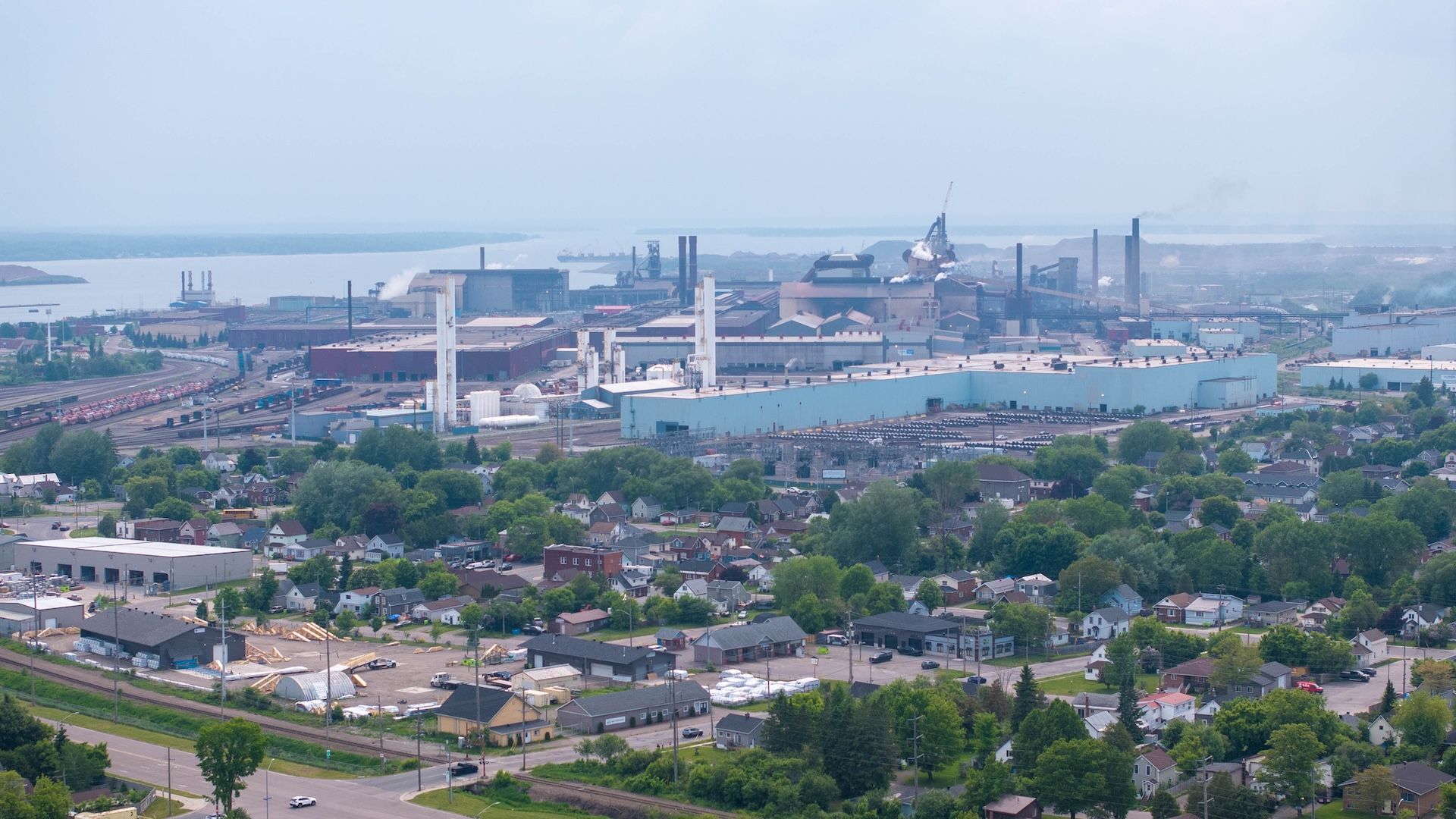
If you drive north across the Sault Ste. Marie International Bridge from one to the other, you can see the stacks of Algoma Steel... a place where the transition from coal-fired to green steel is coming to life. It's a transition already showing real emissions-reduction results, if not without its complications.
The coal-to-clean transition comes to Algoma
The Algoma Steel Plant has operated for 125 years (since 1901). Over the course of more than a century, it has become a major North American supplier, Canada's second-largest steel producer, and the country's only producer of discrete plate steel products. It's also the largest employer on the Ontario side of the bridge.
Until very recently, Algoma's steel production relied exclusively on coal and coke in traditional blast furnace and basic oxygen furnace systems (BF/BOF).
But after more than 120 years, that began to change five years ago last month. In July 2021, Algoma and the Canadian government announced a green steel transition plan. The company has called it the single largest decarbonization project in Canada, with the potential to reduce the plant's emissions by up to 70%.
The cornerstone of the transition is a move to electric arc furnace (EAF) steelmaking. Rather than smelting iron ore with coke at extreme temperatures, EAF uses a combination of recycled scrap steel plus lower-emissions iron ore from sources like direct reduced iron (DRI) and hot briquetted iron (HBI). This approach can reduce emissions by an estimated 50% or more compared to traditional blast furnace production --- while providing a path to nearly net-zero steelmaking.
Four years later, in July 2025, Algoma announced the first arc and first steel production from its new EAF Unit One. The lower-carbon steel that comes off that line is known as Volta. Algoma plans to bring EAF Unit Two online later this year.
In the meantime, heavy US tariffs on Canadian steel and other market pressures prompted Algoma to close down its last remaining blast furnace in January earlier this year, one year ahead of schedule. Algoma is now exclusively an EAF producer of green steel.
But has the green steel transition delivered the promised emissions reductions?
Algoma's carbon emissions intensity plummets
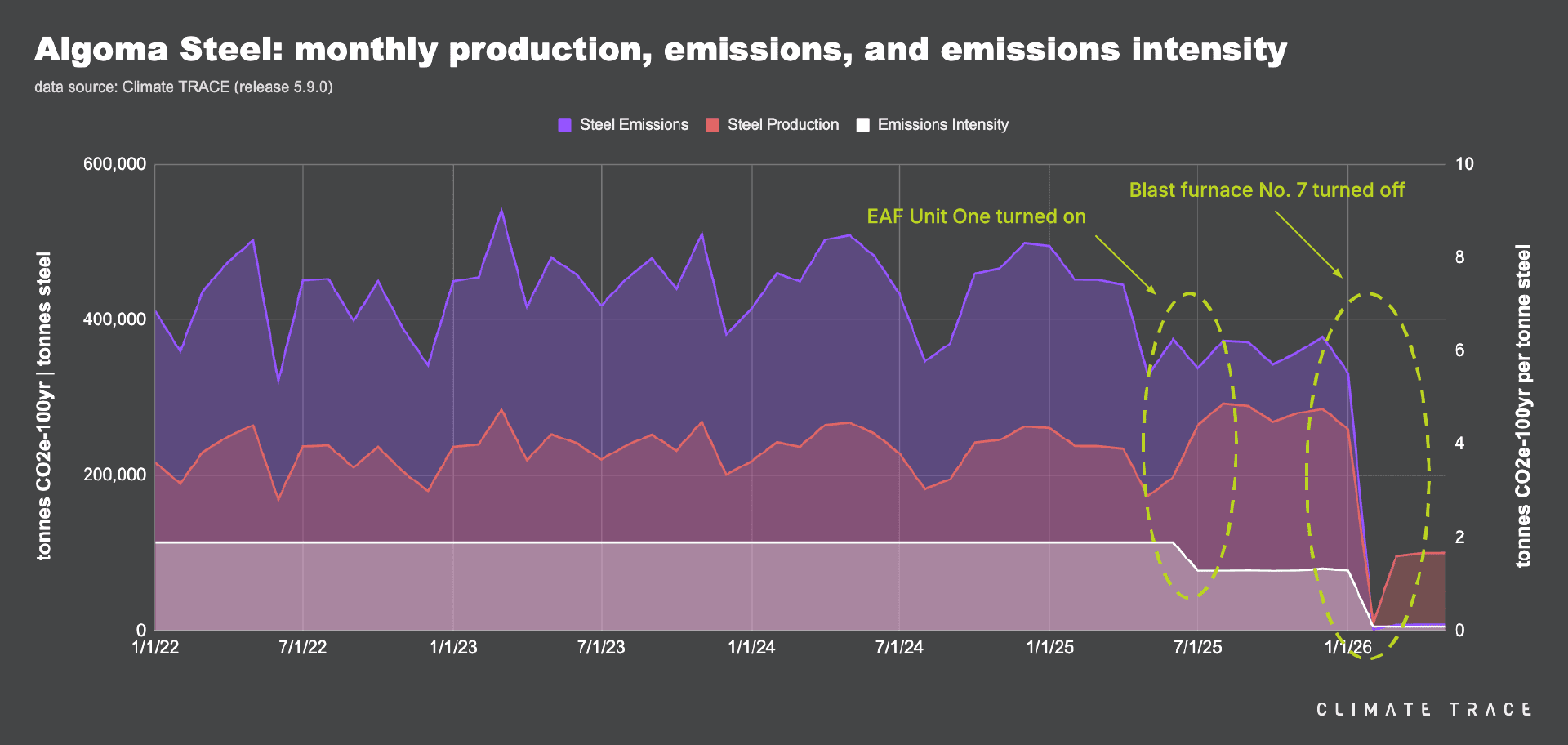
Climate TRACE data offer a detailed glimpse into recent step-change reductions in the emissions intensity at Algoma.
Throughout the first half of the 2020s, monthly steel production and emissions at Algoma moved together in lockstep. Then in July 2025 --- coinciding with Algoma turning on EAF Unit One --- Algoma's steel-making emissions intensity and absolute emissions sharply decoupled from steel production.
Between June and July, the emissions intensity fell nearly 33%, from 1.9 tonnes CO2e-100yr per tonne steel to 1.28. In tandem, absolute emissions fell nearly 10%, even as month-over-month production increased by 33%, according to Climate TRACE estimates.
Then in January 2026, Algoma's Scope 1 emissions intensity fell to nearly zero, as it shut down its remaining fossil-fueled furnaces. Emissions naturally fell, too, along with production... at least until Algoma turns on EAF Unit Two later this year.
In reference to its emissions during the first months of this year, Algoma notes that "these figures are not indicative of expected emissions performance at full production. As production levels increase, emissions are expected to rise in absolute terms; however, emissions intensity is expected to remain significantly lower than under our legacy steelmaking configuration due to the structural benefits of EAF steelmaking."
Powering the green steel: Algoma's electricity transition pathway
Even in advance of publicly announcing its green steel ambitions in 2021, Algoma had been quietly planning a pathway, including sourcing the electricity it would need to power its EAF furnaces.
And so in 2018, Algoma purchased Lake Superior Power, a 55 MW combined heat and power plant that had been closed in 2014. In 2022, Algoma announced plans to update and repower the generating station with modern natural gas turbines to achieve 110 MW of potential capacity. The overhauled power plant went fully operational in 2023, in advance of Algoma's first EAF furnace two years later.
The strategic move was meant to shore up its power supply in the immediate term, although the company has broader plans to more fully transition to clean electricity to power its EAF steelmaking. In the years just ahead, Algoma plans to shift Lake Superior Power into a backup power role, and by 2029 hopes to source all of its electricity from Ontario's grid that's heavy in zero-emissions sources of generation.
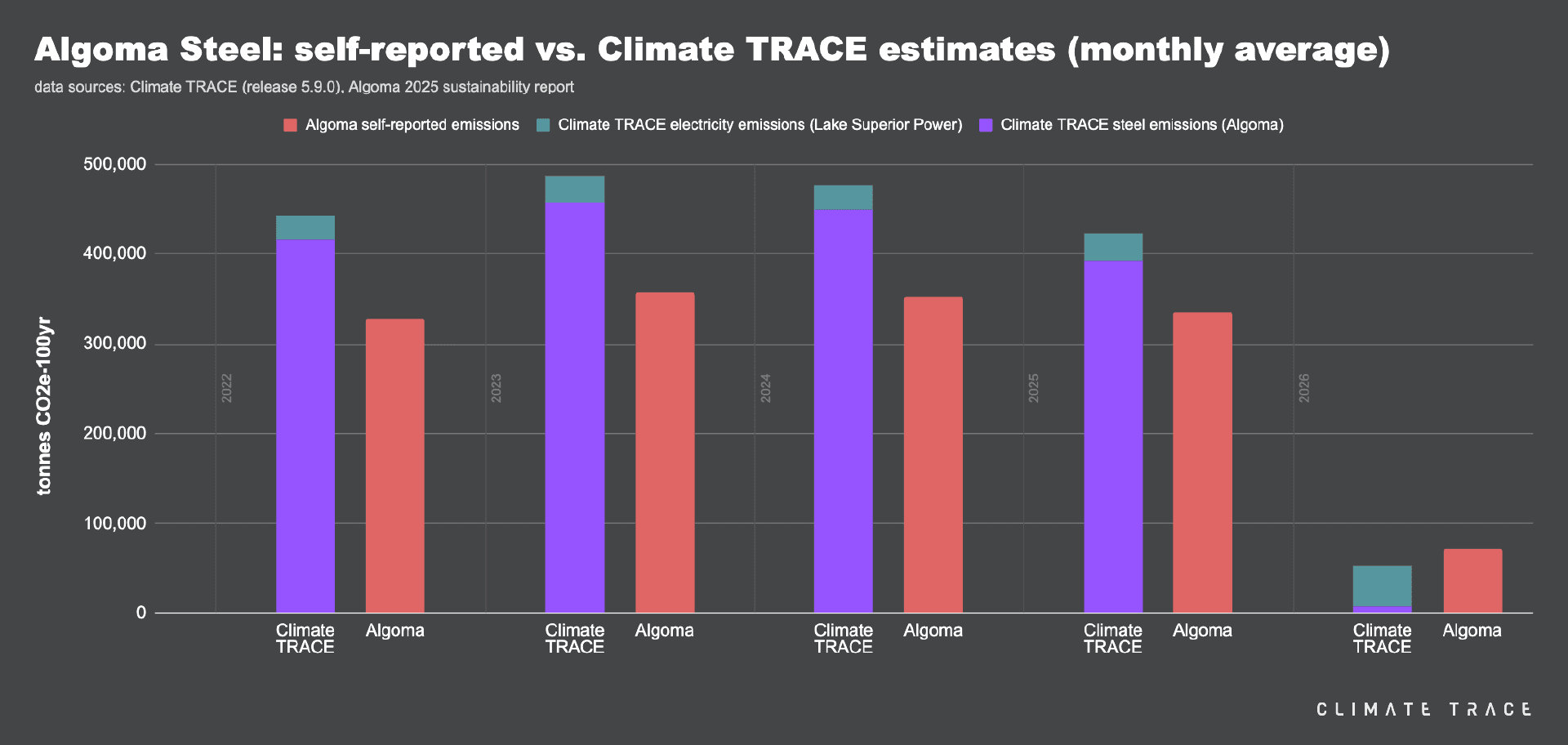
Yet already, Algoma's green steel pathway is reshaping the emissions profile of one of Canada's largest steel producers. And in fact, Algoma's self-reported emissions (per its 2025 Sustainability Report, published June 2026) and Climate TRACE's independent estimates track in parallel.
In the years since Algoma announced its green steel transition in 2021, the company's self-reported numbers and Climate TRACE both agree that average monthly emissions peaked in 2023, although Climate TRACE historical estimates are typically 25--35% higher than Algoma's reported emissions. Both organizations also document a precipitous decline in total average monthly emissions this year --- Scope 1 emissions as reported by Algoma and EAF steelmaking plus Lake Superior Power's direct emissions as modeled by Climate TRACE --- with Climate TRACE emissions estimates coming in lower than Algoma's self-reported numbers so far in 2026.
The cautious road ahead
Progress is happening fast. And Algoma and Climate TRACE data both tell a promising story of green steel's promise: more, cleaner production coupled with drastically lower associated emissions.
But the picture has since grown more complicated. In May, Algoma's CEO raised the possibility of reactivating the No. 6 blast furnace, a 73-year-old unit kept on standby since being superseded by No. 7 in 1975... meaning the era of blast furnaces may not be entirely over.
If resurrected, the blast furnace would supply pig iron to Algoma's EAF, in the event the company is unable to source sufficient quantities of lower-emissions DRI and HBI iron to feed the EAF. That might not be necessary. Unlike markets such as India, which are facing major structural shortages of scrap steel supply, Canada's steel industry generally has a robust supply of scrap steel to feed EAF steelmaking.
Meanwhile, the heavy impact of US tariffs on Canadian steel have forced the layoff of roughly 1,000 workers, leaving the community caught between the promise of a greener future and the economic realities of the present. Until the second EAF comes online and US tariffs and global steel trade smooths out, steel plant workers and their families are feeling the struggle.
And the bumps in the road haven't stopped there. In mid-August 2026, an unplanned outage at Lake Superior Power has temporarily halted EAF steel production altogether, though Algoma expects the disruption to last no more than a few weeks.
Still, the long view holds. Algoma has committed to carbon neutrality by 2050, and the EAF transition --- turbulence and all --- remains one of the most significant decarbonization bets in Canadian industrial history.
Image credits: Pgiam / iStock, redtea / iStock.