Climate TRACE Releases February 2026 Emissions Data
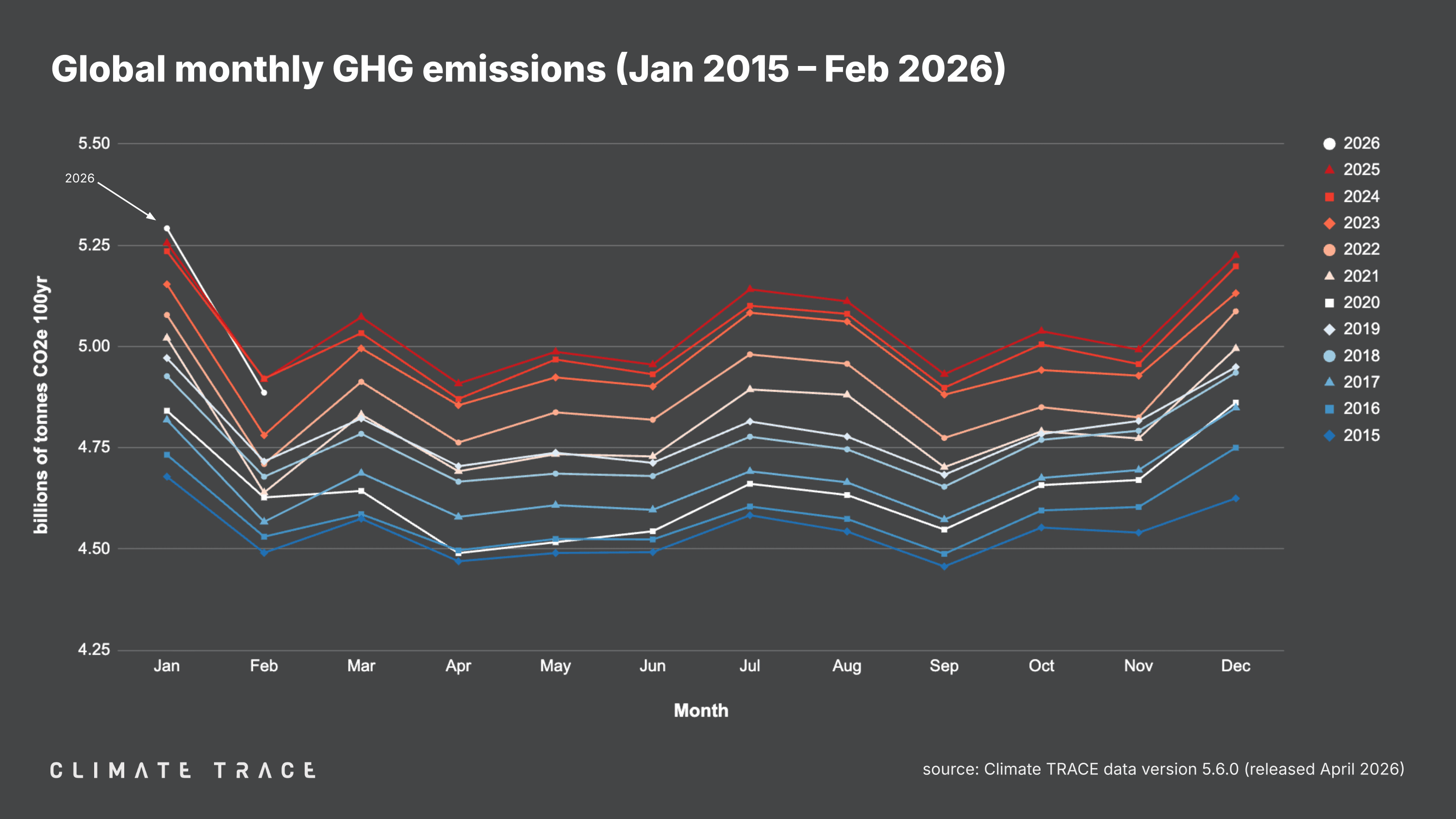
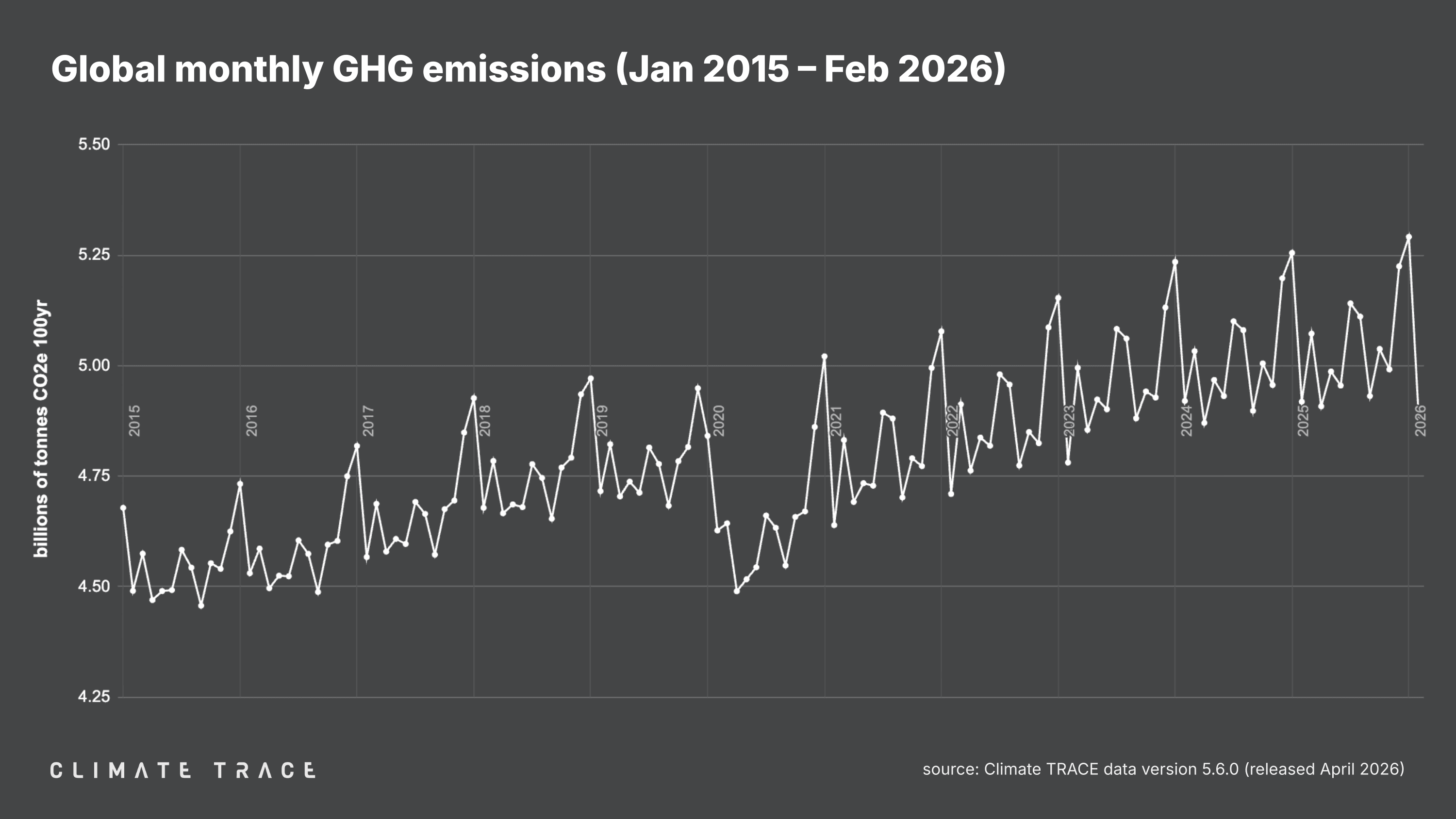
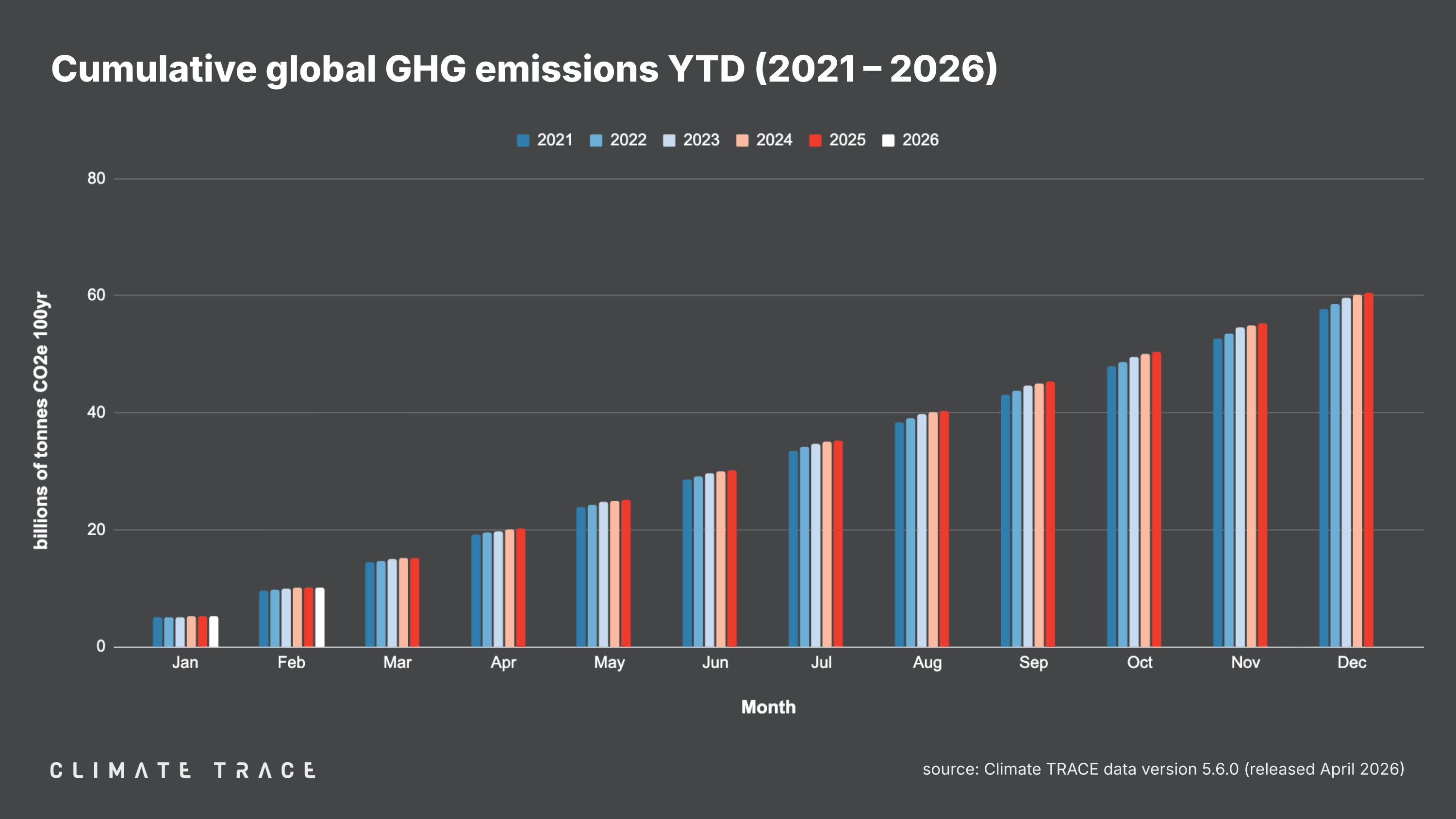
April 30, 2026 – Today, Climate TRACE reported that global greenhouse gas (GHG) emissions for the month of February 2026 totaled 4.9 billion tonnes CO₂e. This represents a decrease of 0.7% vs. February 2025. Total global year-to-date emissions are 10.2 billion tonnes CO₂e. This is effectively equal to 2025's year-to-date total for the same time period. Global methane emissions in February 2026 were 33.0 million tonnes CH₄ — effectively equal to February 2025.
Data tables summarizing GHG and primary particulate matter (PM2.5) emissions totals by sector, country, and the top 100 urban areas for February 2026 are available for download here.
Greenhouse Gas Emissions by Country: February 2026
Climate TRACE's preliminary estimate of February 2026 emissions in China, the world's top emitting country, is 1.4 billion tonnes CO₂e, a decline of 6.3 million tonnes of CO₂e, or 0.4% vs. February 2025.
Of the other top five emitting countries:
-
United States emissions declined by 5.1 million tonnes CO₂e, or 0.9% year over year;
-
India emissions declined by 9.6 million tonnes CO₂e, or 2.8% year over year;
-
Russia emissions increased by 0.6 million tonnes CO₂e, or 0.2% year over year;
-
Indonesia emissions remained effectively flat year over year.
In the EU, which as a bloc would be the fourth largest source of emissions in February 2026, emissions declined by 8.1 million tonnes CO₂e compared to February 2025, or 2.6%.
Data on all other countries and territories are available in our Country/Territory Inventory.
Greenhouse Gas Emissions by Sector: February 2026
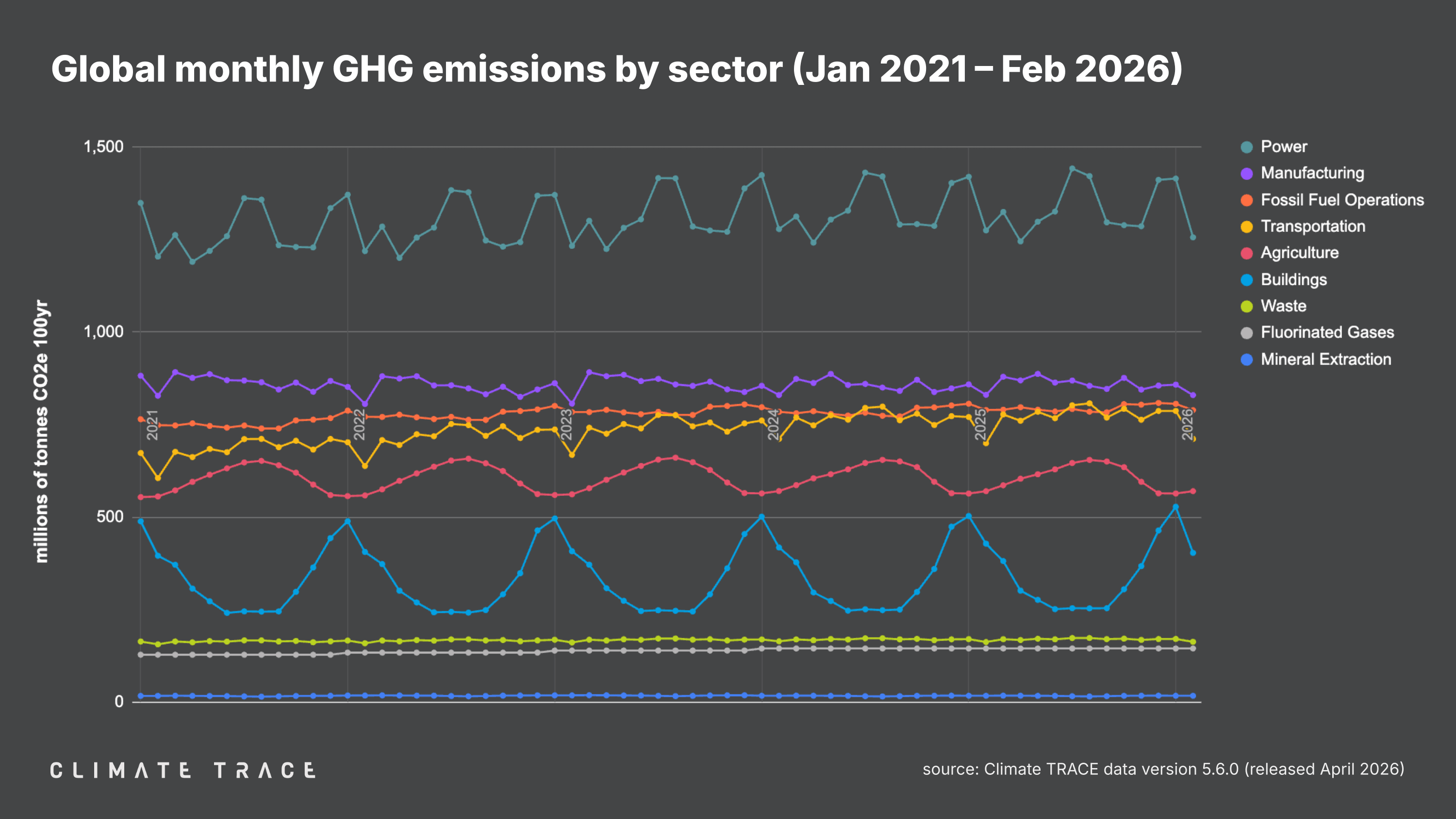
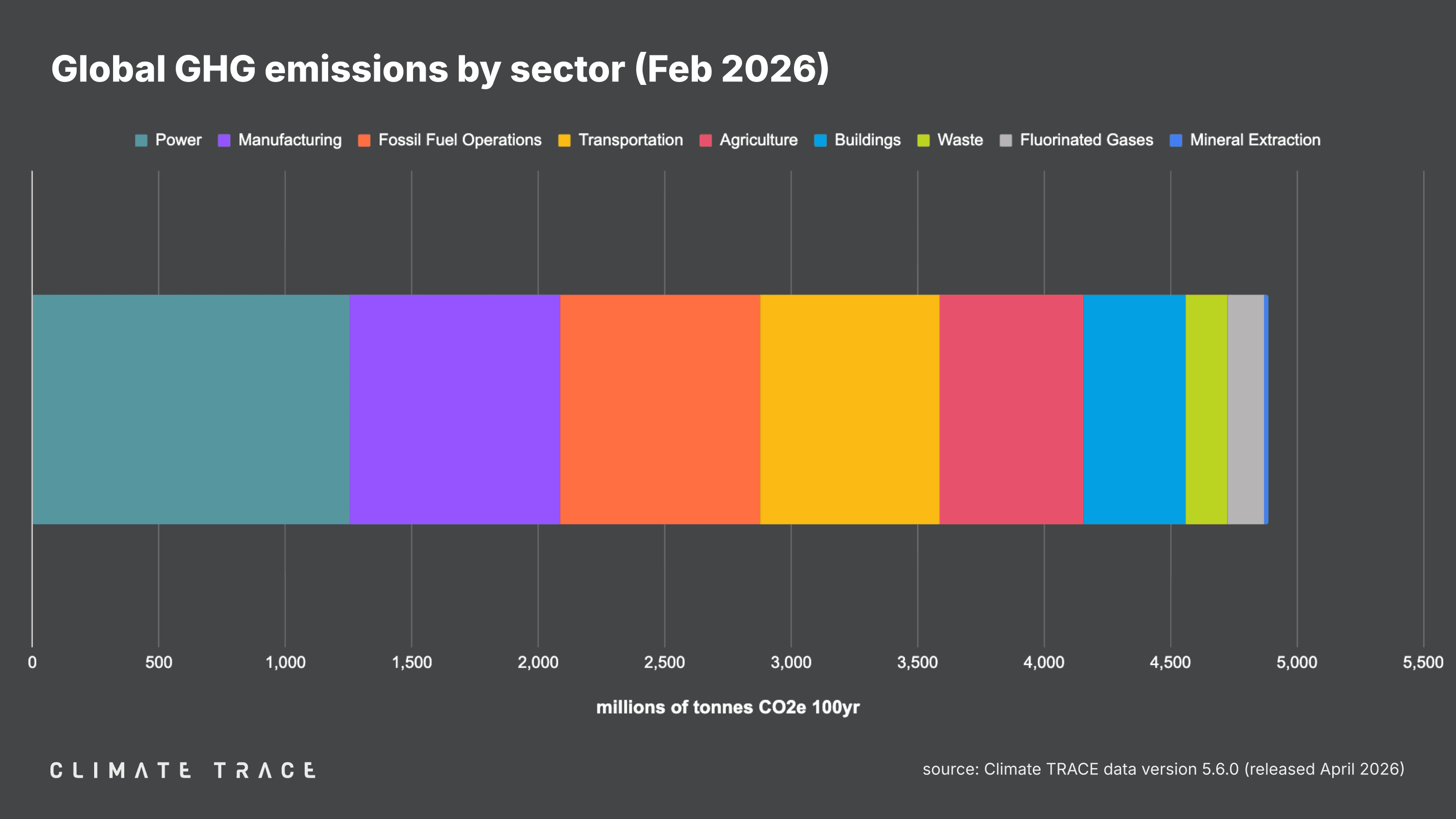
Greenhouse gas emissions increased in February 2026 vs. February 2025 in transportation and waste, and decreased in buildings, manufacturing, and power. Buildings saw the greatest change in emissions year over year, with emissions decreasing by 5.8% as compared to February 2025.
-
Agriculture emissions were 570.2 million tonnes CO₂e, unchanged vs. February 2025;
-
Buildings emissions were 403.4 million tonnes CO₂e, a 5.8% decrease vs. February 2025;
-
Fluorinated gases emissions were 145.0 million tonnes CO₂e, unchanged vs. February 2025;
-
Fossil fuel operations emissions were 789.3 million tonnes CO₂e, unchanged vs. February 2025;
-
Manufacturing emissions were 829.9 million tonnes CO₂e, a 0.1% decrease vs. February 2025;
-
Mineral extraction emissions were 17.2 million tonnes CO₂e, unchanged vs. February 2025;
-
Power emissions were 1,256.5 million tonnes CO₂e, a 1.5% decrease vs. February 2025;
-
Transportation emissions were 711.7 million tonnes CO₂e, a 1.7% increase vs. February 2025;
-
Waste emissions were 163.0 million tonnes CO₂e, a 0.3% increase vs. February 2025.
Greenhouse Gas Emissions by City: February 2026
The urban areas with the highest total GHG emissions in February 2026 were Shanghai, China; Tokyo, Japan; New York, United States; Los Angeles, United States; and Houston, United States.
The urban areas with the greatest increases in absolute emissions in February 2026 as compared to February 2025 were Liuzhou, China; Sanming, China; Ramagundam, India; Shiheng, China; and Surat, India. Those with the largest absolute emissions declines between this February and last February were Ma'anshan, China; Waidhan, India; Tehran, Iran; Tokyo, Japan; and Korba, India.
The urban areas with the greatest increases in emissions as a percentage of their total emissions were Butibori, India; Ocumare del Tuy, Venezuela; Uruguaiana, Brazil; Sanming, China; and Sobradinho, Brazil. Those with the greatest decreases by percentage were Fusui, China; Monclova, México; Zenica, Bosnia and Herzegovina; Mianxian, China; and Xinhua, China.
RELEASE NOTES
Revisions to existing Climate TRACE data are common and expected. They allow us to take the most up-to-date and accurate information into account. As new information becomes available, Climate TRACE will update its emissions totals (potentially including historical estimates) to reflect new data inputs, methodologies, and revisions.
With the addition of February 2026 data, the Climate TRACE database is now updated to version V5.6.0. This release includes a methodology change across four agriculture subsectors (crop residues, cropland fires, manure applied to soils, and synthetic fertilizer application) from yield-based estimations to direct production-based estimations for 2025. Other changes in this release include expanded South African cattle operation coverage (from 108 to 311 assets via the TerraDetect model); greater granularity in US oil and gas production and transport data split by state, basin, and resource type; and 22 new aviation sources added across domestic and international routes.
Additionally, Climate TRACE has updated the underlying data for its emissions reduction scenario planning tool to reflect the latest annual data for 2025.
A detailed description of data updates is available in our changelog here.
To learn more about what is included in our monthly data releases and for frequently asked questions, click here.
All methodologies for Climate TRACE data estimates are available to view and download here.
For any further technical questions about data updates, please contact: coalition@ClimateTRACE.org.
To sign up for monthly updates from Climate TRACE, click here.
Emissions data for March 2026 are scheduled for release on May 28, 2026.
About Climate TRACE
The Climate TRACE coalition was formed by a group of AI specialists, data scientists, researchers, and nongovernmental organizations. Current members include Carbon Yield; Carnegie Mellon University's CREATE Lab; CTrees; Duke University's Nicholas Institute for Energy, Environment & Sustainability; Earth Genome; Former Vice President Al Gore; Global Energy Monitor; Global Fishing Watch/emLab; Johns Hopkins University Applied Physics Lab; OceanMind; RMI; TransitionZero; and WattTime. Climate TRACE is also supported by more than 100 other contributing organizations and researchers, including key data and analysis contributors: Arboretica, Michigan State University, Ode Partners, Open Supply Hub, Saint Louis University's Remote Sensing Lab, and University of Malaysia Terengganu. For more information about the coalition and a list of contributors, click here.
Media Contacts
Fae Jencks and Nikki Arnone for Climate TRACE